What Breaking Bad got me thinking about, and what it might be getting you to think about too.
Last night he was watching Breaking Bad.
Now he was driving to work, thinking about the main character.
He noticed how Walter White lived a suppressed life. Head down. Doing the right thing. Working hard. And then he heard a familiar voice from somewhere further back, good boys don’t do that.
It was from his childhood.
The moment that changes everything
He kept thinking. The moment Walter reached his boiling point, he had a choice. And he chose to have a say in his own life. The moment he did, all those latent capabilities came alive. He came alive.
The path Walter took wasn’t one worth following. But the moment, that specific moment of choosing himself, that was worth sitting with.
He turned the question on himself. Where was he compromising? What might be lying dormant inside him? And if he were to reach a boiling point, what would it be?
Nothing came to mind.
Until a few hours later
He was in a meeting. And he heard himself agree to something he normally wouldn’t.
He went quiet. Not because he had nothing to say, because he suddenly saw it clearly. His response hadn’t come from him. It had come from an expectation of who he was supposed to be in that room.
He had worked so hard for this position. And somewhere along the way, the position had started working on him. Defining how he responds. How he shows up. How many of his choices weren’t really his at all.
Then he remembered something.
What had been quietly set aside
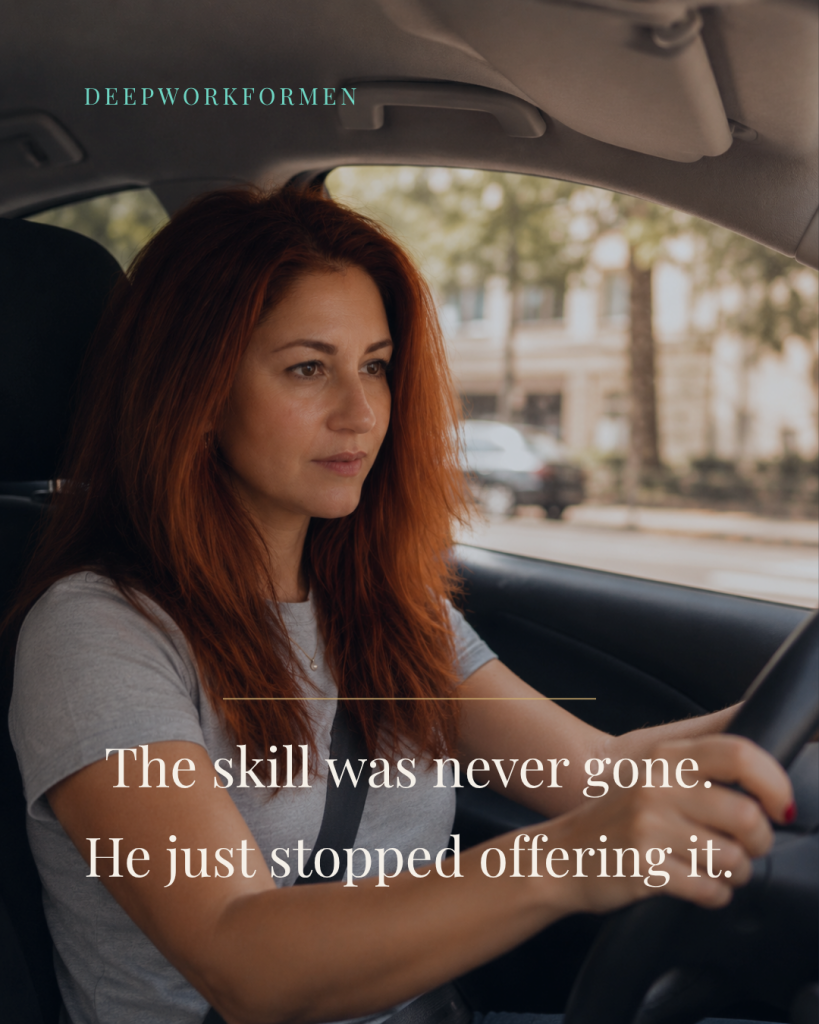
One of his sharpest abilities, the one that could read a system, trace its logic, and know exactly where it was heading — hadn’t been used in years.
Not because it was gone.
Because somewhere between becoming who everyone needed him to be, he had quietly stopped bringing it.
This is what suppression actually costs. Not drama. Not a breakdown. Just a gradual, barely noticeable narrowing, until the version of him that shows up in any given room is a managed, approved, acceptable version. Not a false one. But not the full one either.
What the research says, and what it doesn’t
Studies on men’s identity consistently show the same pattern: men compromise themselves most in the career domain, not because work matters more to them than family, but because for most men, work becomes the primary arena where identity is built, tested, and eventually confined.
The “I am my job” identity is so thoroughly constructed over years that when the job changes, is lost, or simply stops feeling like enough, there’s often nothing underneath it. Not because nothing was there, but because it was never developed in parallel.
What gets lost isn’t always visible. It’s the skill that doesn’t get brought to the meeting. The opinion that doesn’t get offered. The instinct that gets overridden because it doesn’t fit the role. Accumulated across years, this is how a man ends up functional, successful, and fundamentally disconnected from himself.
The Breaking Bad question, properly framed
Walter White’s story is a cautionary tale, not a blueprint. The choice to become something destructive in order to feel alive is its own kind of suppression, just louder.
But the question the story raises is a real one: how many men are living a version of Walter’s pre-crisis life? Competent. Reliable. Meeting expectations. And somewhere underneath all of it, carrying capabilities, instincts, and ways of seeing the world that never get brought into the room.
Not because they were taken. Because they learned, early, quietly, thoroughly, that good boys don’t do that.
What becomes possible when that changes
The work I do with men isn’t about rebellion. It’s not about burning down the career or walking away from the responsibilities.
It’s about finding what was there before the suppression began. The belief that was installed before the man was old enough to choose it. The pattern that’s been quietly shaping every room he walks into.
When that gets addressed at the root, not managed, not reframed, actually resolved, something shifts. The meeting becomes a different experience. Not because the meeting changed. Because he shows up differently in it.
The skill was never gone. It just needed permission to come back.
If something in this is landing, the conversation is free.
Cristina Girleanu
RTT® Practitioner · Spirit Release Facilitator · Rahanni Celestial Healer
cristinagirleanu.com